The Public Record
Read the source documents
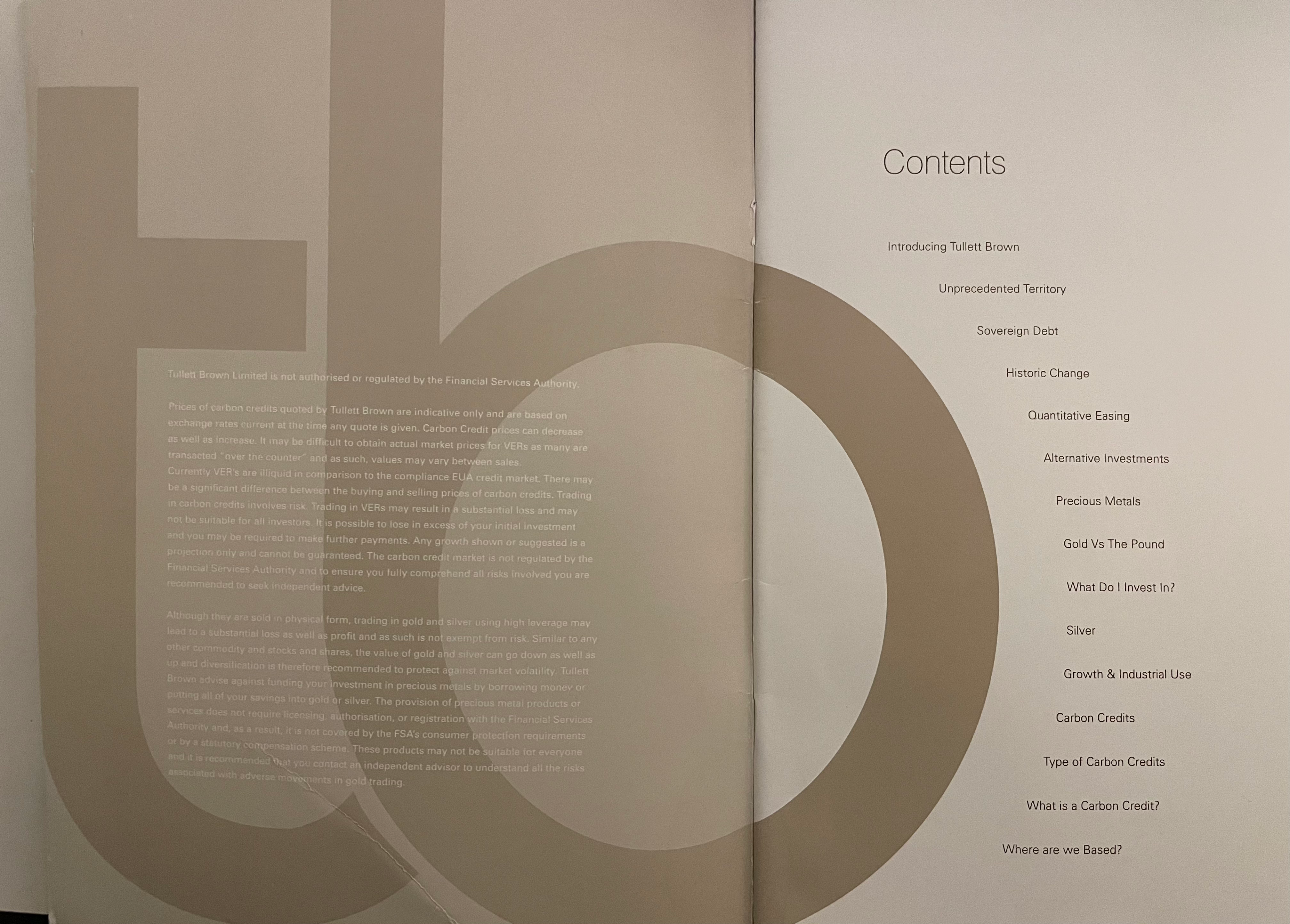
Carbon and precious-metals risk warning
The original brochure spread includes warnings about price changes, liquidity and trading risk. Open the full-size image to read it.
THE CARBON CREDITS ARGUMENT
Carbon credits by their very nature were designed to have value. For a newspaper to claim that carbon credits are worthless is plain idiotic.
My very first question to the newspaper would be, does it have a corporate social responsibility programme? Are they looking to reduce their carbon footprint? Are they purchasing voluntary carbon credits? (And if so, at what price?)
If the answer to any of these questions is yes, then I rest my case!
To return to our argument, why would governments all over the world spend billions in funding massive industrial renewable energy projects in developing countries to produce carbon credits if they are ultimately worthless?
Context and backdrop
After the ratification of the Kyoto Treaty, governments around the world agreed to reduce their carbon emissions by 2012. Carbon Credits were a brand new concept. It was impossible to say either way exactly what the future would hold.
What is a carbon credit?
A carbon credit is a term used for any tradable certificate or permits representing the right to emit one tonne of carbon dioxide (or sometimes other greenhouse gas with an equivalent value to one tonne of carbon dioxide). Governments introduced carbon credits and carbon markets in an attempt to mitigate the growth in greenhouse gases.
Carbon credits were created by the formation of renewable energy projects all over the world.
Each carbon credit is a certificate, which allows one metric ton of carbon to be released into the atmosphere. This meant that businesses and individuals could reduce their carbon emissions by buying carbon credits, as this would effectively offset their carbon footprint. The bigger the footprint the more carbon credits they needed to buy.
It’s also worth noting that renewable projects around the world were very limited. We felt that demand for carbon credits could outstrip supply thus potentially increasing the price of carbon credits in the long term. This is a reasonable assumption.
Voluntary carbon credits were not compulsory. These were designed for those climate-conscious businesses and individuals that wanted to offset their carbon emissions voluntarily as well as having the kudos of “doing their bit for the environment”. This did much to enhance the environmental aspect of their corporate social responsibility. We believed this voluntary market had great potential as both businesses and individuals would make conscious decisions about whom they did business with based on their green credentials. This was an incredibly exciting prospect.
Seeing this market as the next best thing, we even set up a separate company (Carvier limited) to offer carbon offsetting exclusively to businesses. As well as building a carbon offsetting from scratch, this would also provide Tullett Brown clients with an opportunity to sell their holdings to their business customers. Tullett Brown would charge a commission on sales. I will speak about this in more detail later.
Are carbon credits a scam?
Absolutely not. All of the carbon credits that Tullett Brown sold were UNFCCC (United Nations Framework Convention for Climate Change) certified.
Carbon credits were designed to help reduce carbon emissions. They were also designed to have value. As a result, the carbon market is thriving today! Our clients were purchasing carbon credits on the basis that the market would potentially develop to a point where they could be sold at a profit.
The activity surrounding climate change today makes it clear that a market exists for certified voluntary carbon credits. Check out this article:
Are Carbon Credits worthless?
No! It’s very easy for journalists to make outlandish sweeping statements such as, ‘carbon credits are worthless’. Anyone with any common sense should listen to investment professionals on this matter rather than ‘investigative journalists’ who have zero interest in correctly informing the public. Please refer to the videos below:
Goldman Sachs video discussing the voluntary carbon market - are Goldman Sachs discussing carbon credits because they are worthless?
https://www.youtube.com/watch?v=3l9hQYYHrk4
Ex-Goldman Sachs strategist discussing the overall value of the carbon market.
https://www.youtube.com/watch?v=FV1U6K-3hqw
To put this in perspective, the voluntary carbon market today is worth more than one billion dollars. So how can the same standard of carbon credit have value here, but no value as far as the Nwikpos are concerned? You probably know the answer by now.
Tullett Brown specialised in voluntary carbon credits. Today, these credits are bought and sold all over the world, totalling billions of dollars.
£74 per carbon credit today!!!
On this website, you can voluntarily offset the carbon emission on your next flight by buying carbon credits:
https://co2.myclimate.org/en/flight_calculators/new
Example:
London to Adelaide
5.2 metric tonne
COST: £127 - £389 depending on which sustainable development project you choose.
COST PER CREDIT: £24 - £74
Click on the link above to try it for yourself.
Are these carbon credits also worthless?
If carbon credits can be sold today for as much as £74 then surely there is a market for voluntary carbon credits. Tullett Brown sold voluntary carbon credits in 2011 for £6.90.
https://www.climateimpact.com/
Climatecare.org are currently charging £7.50 per carbon credit. These are voluntary carbon credits which are of a similar standard of carbon credit that Tullett Brown were selling in 2011.
Is Climate Care running a scam?
Are Climate Care selling worthless carbon credits?
What is Climate Care’s unit price?
Are there any investigative journalists up in arms about this?
Did we overcharge our clients?
No - again I make the same argument about our business costs. It would be utterly ridiculous not to factor in the running costs of our business. See the list of our costs here .
As you have seen above, voluntary carbon credits can be sold for as much as £74.
Is there a secondary market?
Contrary to the government and media reports, there is a secondary market for carbon credits as companies and individuals all over the world are voluntarily offsetting their carbon emissions. To achieve this they are purchasing carbon credits. Tullett Brown was in the process of building out an infrastructure to create a viable secondary market for our clients and the wider market. See Carvier here . As I mentioned earlier, transparency is the key. Our clients were aware that the carbon credits were illiquid and the market would need to develop.
Airline Companies & Carbon Credits
In 2012, airline companies were selling voluntary carbon credits for as much as £30.00 to their customers. When you book a flight and you are asked on the website if you would like to offset your carbon emissions if you choose yes, in most cases you are purchasing a carbon credit at the enormous price of £30.00. These carbon credits were of the same standard as those sold by Tullett Brown.
So the question needs to be asked: Why weren’t the “investigative journalists” calling the airline companies scammers for charging exorbitant prices and not disclosing their base unit prices?
There is no answer to that one.
So how can it be that Tullett Brown was scamming their clients by selling “worthless” UNFCCC-certified carbon credits for £6.90 each when airlines are charging up to £30 for the same types of carbon credit?
It's clear that airline examples not only prove without a doubt that there was a developing secondary market for carbon credits, but it also shows that Tullett Brown’s purchase price of £2.00 per credit and selling for £6.90 is perfectly reasonable, especially when you consider our operating costs and the prices that carbon offsetting companies are charging today. This proves both the market and the value was there!
This also proves
The £6.90 we charged our clients is NOT extortionate.
There is clearly an appetite for businesses and individuals wanting to offset their carbon footprint by purchasing carbon credits.
There was an opportunity to capitalise on this as a business when a market clearly existed.
Did Tullett Brown mislead their clients?
No. Our clients were fully aware of the nature of the product and the risks that the investment posed. Our clients were also aware that the investments in carbon credits were illiquid and would require further development in the marketplace to resell. Had we been around today, our infrastructure would have been built out and I am in no doubt that our clients would have made a profit.
We made great efforts to explain this to our investors as well as including a risk-warning page.
On the very first page of our brochure, it clearly states that VER credits are illiquid. Please take the time to read the warning page. Also, note that this was not hidden on an obscure back page with tiny barely legible small print. It is clearly shown on the VERY FIRST page so that it would be unmissable and easily seen.
Wouldn't a notice such as this hinder our ability to scam?
If carbon credits can serve as investments for businesses all over the world today, then why couldn't they serve as investments to our clients?
Why couldn't the Tullett Brown Carvier setup work for our clients?
Summing up the carbon argument, when placed in its correct context it’s easy to see what we were trying to achieve. In 2012, carbon credits were a new and exciting market. Every client signed (either manually or electronically) our Terms Of Business before engaging in any sales activity. Our clients were fully aware of the nature of the product and the associated risks. This was made absolutely clear. Contracts were signed and we delivered the full title to every single client.
So where is the scam?
Best Commodities Broker 2012
In 2011, Tullett won the BEST COMMODITIES BROKER AWARD. This was given by the World Finance magazine and we were invited to a ceremony at the London Stock exchange to collect the award.
There was no mention of this anywhere. Not in the government press releases or the media.
Since then, efforts have been made to discredit the magazine but winners in other categories included finance heavyweights such as Goldman Sachs, CitiGroup, UBS and Credit Suisse . So is the inference that they have also infiltrated and scammed the award too?
We also had a write-up in the World Finance magazine here .
You can also see the award video here:
https://www.youtube.com/watch?v=FZDuIEfd4_k
The media wants you to think that we are nothing but a bunch of Nigerian scammers. The truth is that we built a successful business and were recognised by a leading financial publication.