The Public Record
Read the source documents
Land risk warning
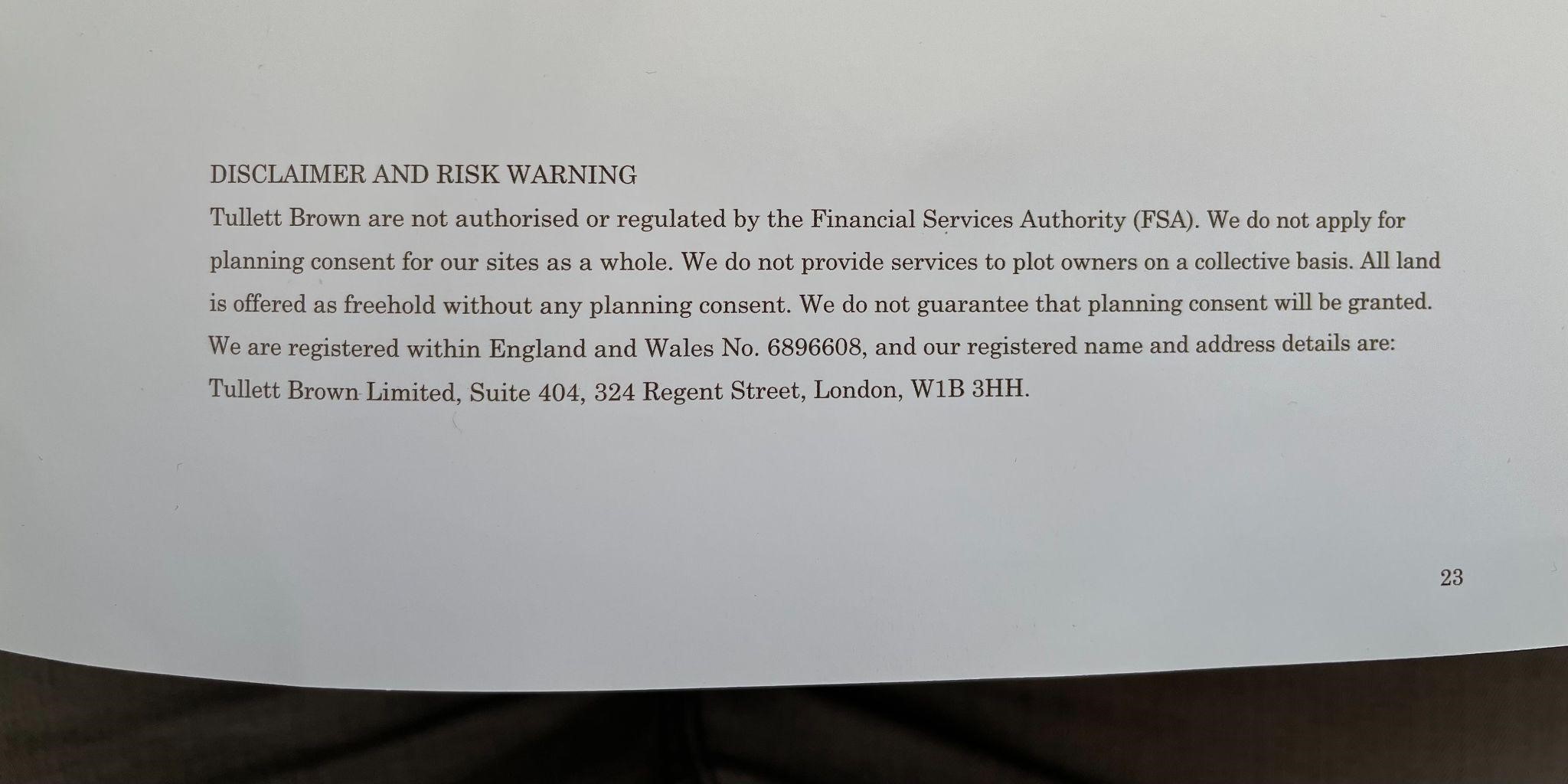
The brochure says that land is offered freehold without planning consent and that consent is not guaranteed.
Planning FAQ
The reproduced FAQ says it is not possible to guarantee when or whether planning consent will be received.

LAND ARGUMENT
Strategic land investment is the practice of buying land without planning permission with the hope that one day, planning will be granted. Land without planning can increase dramatically in value if permission is granted.
Greenbelt land is an area that has been restricted from development to preserve the UK’s open green spaces and to prevent urban sprawl. Over the last 20 years, the restrictions on Greenbelt land have been relaxed and now thousands of acres of what was once Greenbelt land are being developed all over the UK. THIS IS A FACT. Check your local area and you will undoubtedly find developments on what was once restricted Greenbelt land.
There is no difference in classification to the Greenbelt land, which the government is currently releasing for development, to the Greenbelt land that Tullett Brown traded in.
Context and Backdrop
For those who are not aware, Britain has a massive housing shortage. In 2004, the government commissioned a review by Kate Barker to assess the housing crisis.
Some of the findings were as follows:
- Britain truly is facing a massive housing shortage
- More land would need to be released for development and this would have to include restricted Greenbelt land
The outcome was that Britain needed to build 3.2million new homes by 2020 and that more Greenbelt land would need to be released to meet the demand for new housing. That’s over 200,000 new homes every year from 2004. At that time, we were building only a fraction of that.
But where were all of these new houses going to go? This was the catalyst for the biggest shake-up and revision of Britain’s planning laws in recent history. As a result of this, more investors began speculating on Greenbelt land knowing that if the government were to meet its targets, investors would be in a very strong position as they would have title to this much-needed land. With this in mind, Tullett Brown was founded to offer land without planning permission (including Greenbelt) as a speculative investment. All our material had the following disclaimer (SEE HERE).
Were our clients aware that the land we offered was currently Greenbelt?
Yes, they were. This was made 100% clear.
So when the Insolvency Service and media made claims that our clients did not know the land was Greenbelt this was untrue. Any self-respecting investigator or journalist only had to pick up one of our brochures to see that this was not the case. A glance at page 19 dispels that myth. This couldn’t be any clearer, in that we openly traded in Greenbelt land.
If you look at the page from the brochure below, you will see that the page is headed
‘Why Greenfield/ Greenbelt and not Brownfield?’
The double-spread centre pages of our brochure discuss land without planning and the potential for re-zoning. It is made transparent that Tullett Brown was originally set up for this very purpose. We offered Greenbelt land as a speculative investment to our clients.
The idea was to purchase land in areas of high housing demand. We would divide the land into housing estate-sized plots. We sold the Greenbelt land to our clients, whilst retaining a portion of the land for Tullett Brown for our investment. This was our business model. We invested in our own land!
What type of land did Tullett Brown buy?
We purchased land in areas where new homes were needed. We specifically chose sites adjacent to or next door to existing property developments.
See the example below. This was done transparently because throughout the UK massive sways of Greenbelt land were being released for housing development.
This link provides an idea of the sheer volume of previously restricted Greenbelt land, which is now being developed for housing:
https://www.winfieldsoutdoors.co.uk/blog/uk-green-belt-disappearing/
If we accept the media’s narrative that investing in Greenbelt land is a scam then it should follow that all previous Greenbelt sites developed for housing were scams. This was clearly not the case as the government had sanctioned the go-ahead for building. It’s very clear that this only becomes a scam when three Nigerian brothers became involved. The press already had their own narrative set.
Land banking is not a scam and never has been. It's outrageous to suggest that it is. Yes, it's highly speculative but that's the name of the game.
It's also worth noting that some of the largest investors in restricted Greenbelt land include housebuilders, supermarket chains, family offices and private investors. Why would they buy this land if it were worthless or impossible to achieve planning on?
For years, the media has been writing articles about Greenbelt land being under threat. But they don’t refer to any of these previous articles when writing about the ‘Nwikpo Land Scam’. This was a headline completely fabricated by the press to attract attention and sell newspapers.
See examples of previous articles below.
https://www.essexlive.news/news/essex-news/new-specialist-dementia-care-home-6824846
https://www.nottinghampost.com/news/local-news/work-starts-major-project-build-6775848
https://www.edinburghlive.co.uk/news/plans-500-new-edinburgh-homes-23268651
https://www.thecomet.net/news/local-council/building-on-green-belt-land-near-hitchin-8610196
https://www.sthelensstar.co.uk/news/19898352.plans-for130-homes-green-belt-near-lodge-lane-haydock/
https://www.buckinghamshirelive.com/news/buckinghamshire-news/pinewood-studios-bucks-Greenbelt -land-6366490
https://www.hertfordshiremercury.co.uk/news/hertfordshire-news/plans-66-homes-former-green-6051121
https://www.hertfordshiremercury.co.uk/news/hertfordshire-news/green-light-new-1500-home-6387249
Staffordshire Council say it 'impossible' to build without Green Belt Development!
It’s amazing what is revealed when information is placed in its correct context. The articles above prove that Greenbelt land is constantly being re-zoned and achieving planning for housing development.
The land that we offered was no different in terms of classification to that mentioned in any of the articles above.
Did Tullett Brown make promises that the land WOULD receive planning permission?
Absolutely not!
Nowhere in the brochure (or the training manual or sales scripts) does it say that planning is guaranteed or even probable. By way of example, in the FAQ’s section (“DN1” pages ) under the heading “ Will Planning Consent be Granted?” it states the following:
“It is not possible to give any guarantee as to when or whether you will receive planning consent. We always ensure that the sites and plots that we source are in areas where there is a demand for new housing”
Our brochures and sales material make this very clear. On the same page under the heading “ Disclaimer and Risk Warning ” , it states:
“……….we do not guarantee that planning consent will be granted……”
The interpretation placed on the selective parts of the brochures highlighted in the Insolvency Service evidence is misleading and taken out of context. When read as a whole, it is plain that prospective customers were properly informed before deciding to proceed with the purchase.
It is also noteworthy that little or no genuine issues or complaints were raised before winding up and where clients did change their minds (both after paying just a deposit and after completion), full refunds were immediately given (see below).
I will only accept that Greenbelt land investment is a scam when the government stops releasing Greenbelt land for development, which is subsequently sold on for millions.
The argument has been made to say that the local authority said that our land had little to no chance of gaining planning permission.
This is true. But it is also true for ALL GREEN BELT LAND IN ENGLAND.
The local authority can only comment on the land in its current status . If the current status is restricted Greenbelt, then the only opinion they can give will be based on the restricted Greenbelt rating, which is correct.
The Insolvency Service and the media are well aware that this is a nonsensical argument. This is because BUILDING IS BEING CARRIED OUT ON PREVIOUSLY RESTRICTED GREEN BELT LAND EVERYDAY! This is the very same type of land that would have had little to no chance of gaining planning permission before it was re-zoned.
The media is saying that what we are doing is a scam whilst being fully aware that local authorities are re-zoning the very same classification of Greenbelt land for development every day. Who is telling the truth here?
What else would you expect the local authority to say?
“Yes, we are going to reclassify that Greenbelt site soon. So buy now while you can and make a fortune!”
If it were that easy to call the local authority to get the hottest tips on future land reclassification then everybody would be doing it!
The argument put forward by the media appears quite damning when reading a mainstream newspaper article about three Nigerian brothers breaking the law but utterly stupid when placed in the correct context. To drive home the point again, if you call your local planning office and ask them to GUARANTEE IN WRITING that a particular Greenbelt site will NEVER BE DEVELOPED, they won’t do it.
Local Authority Green Belt Reviews
This link covers the areas of Greenbelt land surrounding London. Each purple marker represents a Greenbelt land site under threat: http://londonGreenbelt council.org.uk/threats_map/
This is showing us the Greenbelt land that is currently restricted but could be re-zoned in the future. Our clients understood this. This possibility is what our business model was based on.
Did Tullett Brown overcharge for the land?
Not at all, and the figures substantiate this. All businesses have costs and they have to be factored into the sale price of the product. Our business was no different to any other business in that respect.
Tullett Brown had massive overheads for running the business, including the following (which is not intended as an exhaustive list):
- Research costs
- Land purchase
- Solicitor’s fees
- Report fees
- City Of London office rental
- Rates
- Salaries for 30+ staff
- Commissions
- Brochures design & printing
- Telephones
- Leads & marketing
- Training
- Accountants' costs
- Tax
- National Insurance
And much more, including the fact that we had to make a profit. It should also be noted there is no legal requirement for price disclosure or a breakdown of costs.
In addition, a balance needed to be struck between the above costs to the company and the potential gains to be made by the clients if planning was obtained. It is entirely inappropriate and misleading to assess apparent profit by reference to a simple comparison of the price at which the company bought and then sold the land and to then express it in terms of percentages. It completely fails to take account of the foregoing factors.
To make an argument for the prices we paid WITHOUT factoring in our cost or the potential upside if planning was granted is just unprofessional and foolish. Again, this looks great in a damning article but it is cringingly obvious that they were desperate to mislead the public.
The potential upside of a house-sized plot of land with planning permission can be well over 100k. This is a FACT. Many property developers today will factor in the price of land (with planning) to be worth a third of the final development value.
If you are building a house that will have a GDV (completed value) of 300k, you can expect the land (with planning) to be worth circa 100k:
- (⅓) Land
- (⅓) Building Cost
- (⅓) Profit
Summing up the land argument
Now everything has been placed in the correct context, it’s plain to see that our business model was based on the findings of the Barker Review. Greenbelt land is constantly re-zoned for development. We offered freehold Greenbelt land to our clients for speculative investment. Our client fully understood the investment including the fact that the land was Greenbelt. They signed contracts and land purchase agreements.
The newspapers won’t tell you any of this. If this was our business model and our clients were fully aware and signed contracts and received full title deeds, then where is the scam?